
Tree Survey Report Palo Alto CA
Professional Arborist Surveys for Construction and Development
Professional Tree Survey Reports in Palo Alto, CA, to Keep Your Project Moving Forward. Building a new home, adding an ADU, or planning a development project requires careful consideration of existing trees and local regulations. Missing or incomplete tree documentation can lead to costly revisions, permitting complications, and unnecessary construction delays. Align Tree Management provides professional tree surveys, detailed assessments, and practical recommendations to help homeowners, architects, contractors, and developers understand tree-related requirements and make informed decisions. Contact Align Tree Management today to discuss your project and get the professional arborist guidance you need before construction begins.
Get a Consultation
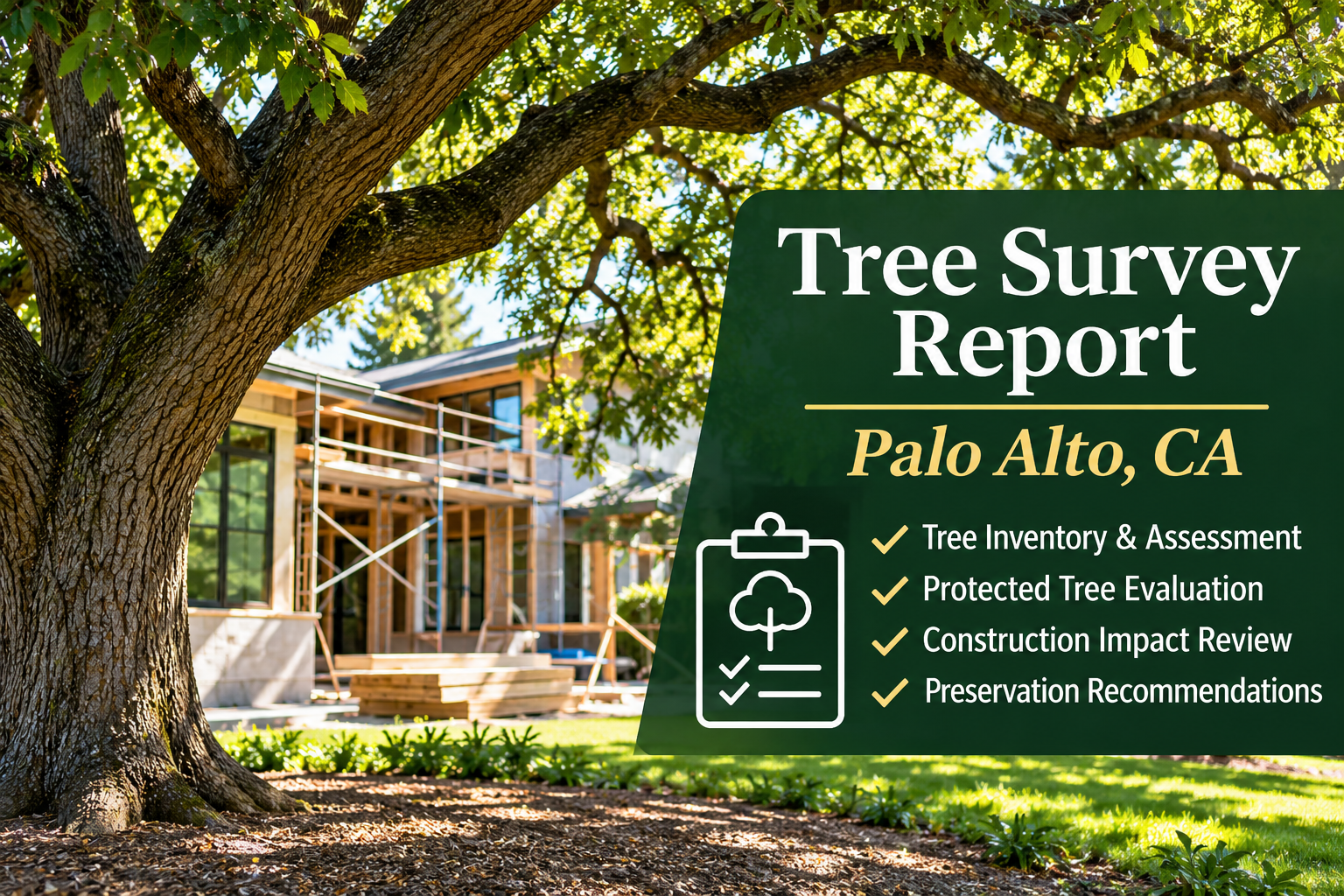
Professional Tree Survey Reports in Palo Alto, California
Palo Alto is known for its established neighborhoods, mature trees, and commitment to preserving its urban forest. These trees contribute to property values, neighborhood character, environmental sustainability, and the overall quality of life throughout the community.
However, existing trees can present important considerations when planning new construction, property improvements, or changes to land use. Before work begins, property owners and development professionals may need a comprehensive understanding of the trees located on or near the project site.
A tree survey report provides that information through a professional evaluation of existing trees, their condition, their location in relation to proposed development, and their suitability for preservation.
Unlike a basic landscaping inventory, a professional arborist tree survey considers both the physical characteristics of trees and the potential effects of construction activities.
Align Tree Management specializes in consulting arborist services, offering independent assessments and recommendations rather than performing tree trimming, removal, or other physical tree work. The goal is to provide reliable information that supports responsible planning, regulatory compliance, and cost-effective tree management.
Why Tree Survey Reports Matter for Palo Alto Development Projects
Tree preservation is an important part of the development review process in Palo Alto. The city's Tree Protection Ordinance establishes requirements for protected trees, while its Tree Technical Manual provides guidance for evaluating trees and protecting them during construction.
When a proposed project affects existing trees, appropriate arborist documentation may be necessary to support the development application and demonstrate how trees will be addressed.
A tree survey report can help identify important considerations before architectural and engineering plans are finalized.
For example, a property owner planning a new residence may have several mature trees near a proposed building footprint. Even when those trees are not directly in the way of construction, their root systems or canopies could be affected by excavation, foundations, underground utilities, or equipment access.
Identifying these concerns early allows the project team to evaluate possible design adjustments and protective measures before construction begins.
Without adequate tree information, changes may be needed later in the permitting or construction process, potentially increasing project costs and delaying progress.
A professional tree survey helps reduce these uncertainties by providing a clearer understanding of existing site conditions and potential tree-related limitations.
What Is Included in a Tree Survey Report?
The information included in a tree survey report depends on the project, the number of trees involved, and applicable city requirements.
Palo Alto's Tree Technical Manual identifies specific information that may be required for tree survey documentation, including tree identification, inventory information, health and structural conditions, and recommendations concerning preservation.
A professional tree survey may include the following elements.
Tree Identification and Inventory
Each tree within the scope of the survey is evaluated and documented. Relevant information may include the tree species, trunk diameter, physical characteristics, and identification number.
A tree inventory helps property owners and project professionals distinguish individual trees and understand which ones may require special consideration.
Tree Health and Structural Conditions
A consulting arborist examines the visible condition of each tree to identify relevant concerns such as decline, decay, damaged branches, structural defects, or other characteristics that may affect its stability and long-term health.
These observations help establish whether the tree is a reasonable candidate for preservation and whether further evaluation or management is appropriate.
Tree Locations and Site Conditions
Tree survey documentation may incorporate site plans identifying the location of individual trees in relation to existing structures, property boundaries, and proposed development.
The arborist may work with surveys and plans prepared by other project professionals to assess the relationship between trees and the proposed construction.
Protected Tree Identification
Palo Alto has specific regulations concerning protected trees. A tree survey helps identify trees that may fall under these regulations and require additional preservation measures or city review.
Preservation Recommendations
The survey may include recommendations concerning which trees are suitable for preservation, potential construction impacts, and measures that could help maintain their health and structural integrity.
Depending on the circumstances, the report may also identify trees requiring further assessment or additional documentation.
Tree Valuation
When required for a particular project, tree appraisal information may be included to document the value of existing trees using recognized valuation methods.
The purpose of these findings is to give project stakeholders organized, useful information for making responsible decisions about existing trees.
Understanding Palo Alto's Protected Tree Regulations
Palo Alto's Tree Protection Ordinance was updated in 2024 to expand and clarify protections for the city's urban forest.
The regulations address several categories of protected trees, including certain native species, qualifying larger trees, designated trees, and publicly owned trees.
Because protected status depends on factors such as species, size, location, and applicable designations, property owners should not assume a tree is unregulated simply because it is located on private property.
Trees on neighboring properties or within public areas may also be relevant when their roots or canopies extend into a proposed construction area.
A consulting arborist can help identify these concerns and provide information needed to determine how proposed work should account for protected trees.
This is especially important when construction involves grading, excavation, foundation installation, utility trenches, or other activities that could disturb tree roots.
While the city determines applicable permit and approval requirements, a professional tree survey can help property owners understand the conditions that may affect their projects.
Tree Surveys for New Homes, ADUs, and Residential Remodeling
Residential improvements are a common reason property owners seek arborist consulting in Palo Alto.
Whether constructing a custom home, expanding an existing residence, or adding an accessory dwelling unit, understanding the location and condition of trees is an important part of responsible site planning.
Trees may affect where buildings can be placed, how utilities are routed, and which areas require protection during construction.
An arborist tree survey can help evaluate these considerations before major design decisions are finalized.
For homeowners, this may reduce the likelihood of discovering unexpected tree-related issues after architectural plans have already been developed.
For architects and designers, tree survey findings can provide useful information when evaluating the placement of structures, driveways, outdoor living areas, and other site improvements.
For contractors, the resulting documentation helps clarify which trees require special precautions and where construction activities may need to be adjusted.
By incorporating tree evaluations into the planning process, property owners can make better-informed decisions that account for both construction goals and long-term tree preservation.
Tree Survey Reports for Commercial Construction and Property Development
Commercial developments and larger residential projects may involve multiple trees, complex site conditions, and additional coordination among project professionals.
A professional tree survey can provide an organized inventory of existing trees and help identify potential conflicts between preservation requirements and proposed development.
This information may be useful for projects involving office buildings, multifamily housing, commercial renovations, new construction, and property redevelopment.
Depending on the project, survey findings may help inform site design, construction access, grading plans, underground utility placement, and landscape planning.
Align Tree Management provides consulting arborist services that help property owners and development teams evaluate these conditions and develop practical recommendations for managing trees throughout the project.
Early assessment can be particularly valuable when mature trees occupy areas under consideration for excavation or construction.
Understanding these limitations before work begins may help reduce redesign, unnecessary expenses, and potential damage to valuable trees.
The Difference Between a Tree Survey Report and a Tree Protection Plan
Although tree surveys and tree protection plans are closely related, they serve different purposes.
A tree survey report documents existing trees, including their identification, physical condition, and relevant site characteristics. It provides the information needed to understand which trees are present and how they may be affected by a proposed project.
A tree protection plan focuses on the measures necessary to protect trees that will remain during construction.
These measures may address protective fencing, restricted access areas, excavation precautions, root protection, monitoring, and other construction-related activities.
For some development projects, the findings from a tree survey help establish the foundation for a more detailed tree protection and preservation plan.
Both types of documentation can be important when planning construction near established trees.
Align Tree Management helps clients understand the purpose of these evaluations and provides recommendations tailored to their project's needs.
How Construction Can Affect Trees That Appear Healthy
One of the challenges of building near mature trees is that damage is not always immediately visible.
A tree may appear healthy before construction begins, yet experience significant stress from disturbances to the surrounding soil or root system.
Excavation can damage or remove important roots. Heavy equipment may compact soil and limit the movement of water and oxygen. Changes in drainage or ground elevation can alter growing conditions, while construction materials placed beneath a tree canopy may create additional problems.
In some cases, the effects of these disturbances do not become apparent until well after construction has ended.
An arborist survey can help identify trees that may be vulnerable to construction impacts and provide recommendations for reducing unnecessary disturbance.
Preserving an established tree can offer long-term benefits, including continued shade, aesthetic value, and environmental contributions.
Evaluating these factors before development begins allows property owners to consider practical solutions rather than reacting to avoidable problems later.
Why an Independent Consulting Arborist Is Valuable
Hiring a consulting arborist offers a different type of professional service than hiring a tree care contractor.
Tree service companies generally focus on physical maintenance activities such as pruning, trimming, and removal. Consulting arborists concentrate on evaluating trees, documenting conditions, assessing risks, and recommending appropriate management strategies.
When a construction project involves protected trees, independent professional guidance can help property owners understand the available options without automatically committing to physical tree work.
Align Tree Management focuses on providing cost-effective, sustainable recommendations based on actual tree conditions and the needs of each project.
The objective is to preserve healthy trees when practical, identify legitimate concerns, and support decisions that balance property development with responsible tree management.
This approach is especially useful for homeowners, architects, builders, and property managers who need clear assessments and professional documentation before proceeding.
Planning Ahead Can Help Reduce Construction Delays and Unexpected Costs
Tree-related issues are often easier and less expensive to address during the planning stages than after construction is underway.
An established tree near a proposed foundation, driveway, or utility trench may influence how a project should be designed. If these concerns are identified late, revisions or additional protection measures may become necessary.
A professional tree survey provides an opportunity to address these considerations earlier.
By reviewing existing trees and evaluating potential construction impacts, property owners and project teams can better understand the conditions that may affect their plans.
Although an arborist report cannot guarantee permit approval or eliminate every construction complication, it can provide valuable information that supports more efficient planning and informed decision-making.
The result is a more organized approach to managing tree-related concerns while respecting the environmental value of Palo Alto's established landscape.
Choose Align Tree Management for Tree Survey Reports in Palo Alto, CA
Align Tree Management provides professional arborist consulting services for homeowners, architects, contractors, developers, and property managers who need reliable information about trees on their properties.
With a focus on objective evaluations and sustainable solutions, the company helps clients understand existing tree conditions, identify potential development impacts, and make practical decisions about tree preservation.
Whether you're evaluating trees before designing a new residence, preparing for an ADU, or coordinating a larger construction project, professional arborist guidance can help you address important considerations before they become costly obstacles.
Align Tree Management's consulting-focused approach emphasizes clear documentation, thoughtful recommendations, and solutions that reflect the needs of both the property owner and the surrounding environment.
Schedule a Professional Tree Survey in Palo Alto, CA
Your construction or development project deserves a clear understanding of existing trees before important decisions are made. Align Tree Management provides professional tree survey reports and consulting arborist recommendations to help you evaluate site conditions, address tree protection considerations, and plan your next steps with greater confidence.
Contact Align Tree Management today to discuss your Palo Alto property, request a professional tree survey consultation, and move your project forward with the information you need.